The practical field guide for families, adult children, and carers. No clinical jargon. No toxic positivity. Just five years of frontline survival, dry British wit, and scripts that actually work.
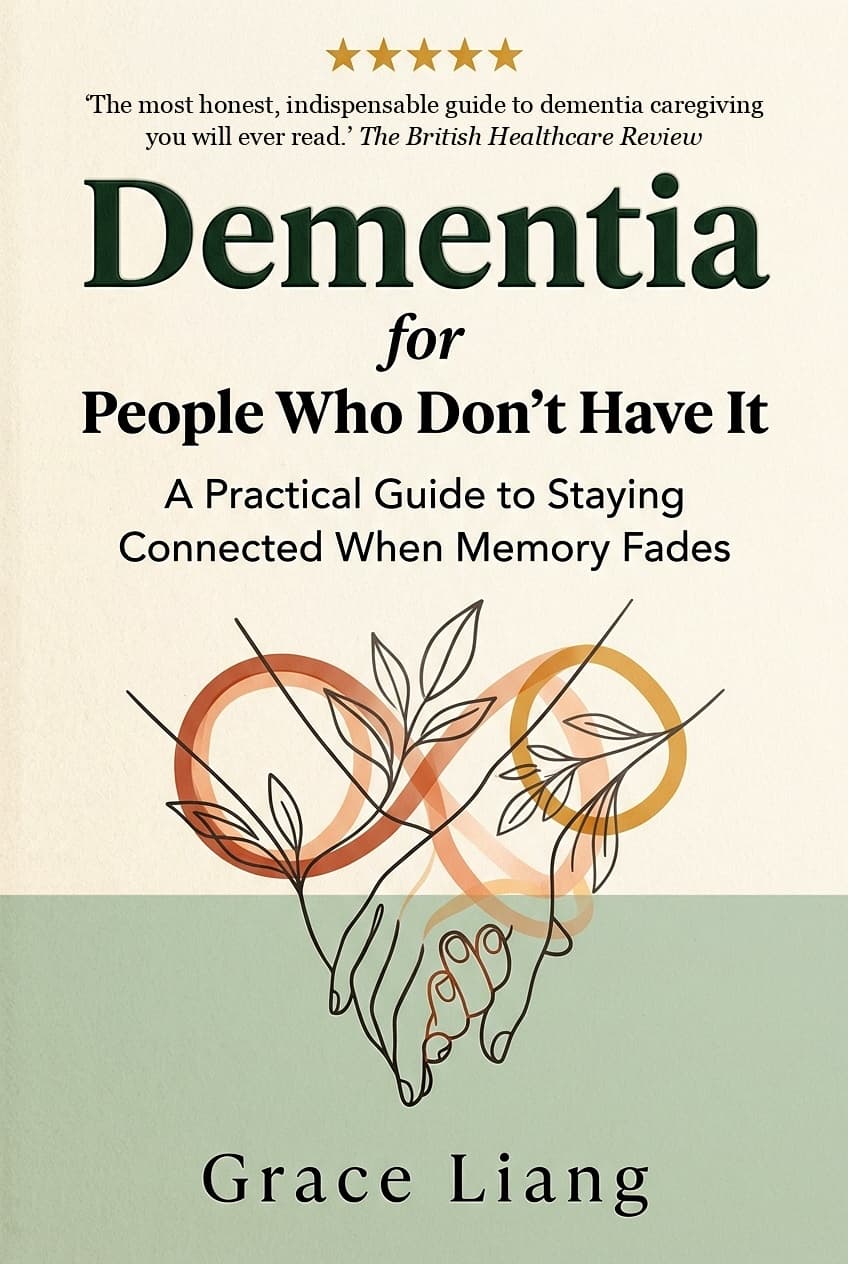
Kitchen-Table Common Sense
Why you do not need another medical textbook to survive Tuesday afternoon.
When a parent receives a dementia diagnosis, your GP gives you a handful of leaflets, a clinic gives you six-syllable terms, and well-meaning friends tell you to remain patient. None of that explains what to do when your mother accuses you of stealing her cardigan, or why your father is trying to unlock the garden shed at three in the morning.
Grace Liang is not a doctor. She is a daughter who spent five years coordinating care, negotiating with social services, and sitting at the kitchen table while the world quietly shifted beneath her mother's feet. This book is the missing manual: an unflinching, practical, and dryly observant guide to what dementia actually looks like from the inside of a British home.
Biological blind spot, not stubborn denial
Never ask open-ended questions
Why reality therapy causes needless grief
Doing your duty while wanting to scream
The Four Principles of Dementia Care
How to stop arguing with biology and protect your own sanity.
01. Why Logic Backfires
We argue, explain, and produce receipts, bank statements, and calendars to prove that today is Thursday, lunch was eaten thirty minutes ago, and nobody broke into the house to move the spectacles.
Step into their world. Their feelings are 100% genuine even when their facts are 100% wrong. Acknowledge the emotion first: 'It is unsettling when things go missing. Let us put the kettle on and have a look together.'
Get the complete field guide on your shelf or e-reader today.
Order now on Amazon UK with immediate dispatch and digital download.
"Mum, your front door key is in the sugar bowl."
Surrey, England. A rainy Tuesday morning. How five minutes in a kitchen taught me everything about dementia.
The rain was drumming steady and relentless against the kitchen window. I had driven over before nine to drop off the weekly shopping. In the kitchen, the kettle had boiled dry twenty minutes earlier, and a slice of toast sat cold and unbuttered on a side plate.
Mum was standing by the sink in her bottle-green woollen cardigan, looking serene. With slow, rhythmic concentration, she was using the blunt edge of an ivory butter knife to stir a mug of tepid black tea.
When we could not find her front door key on the brass hook, we checked her coat pockets, the bottom of her handbag, and under the sitting room cushions.
'Someone has been in the house,' she told me, looking thoroughly pleased with her deduction.
I reached into the cupboard above the cooker for the porcelain sugar bowl to make a fresh cuppa. I drove the silver teaspoon into the sugar, and it struck something solid with a dull metallic clink. Buried three inches deep was her heavy brass door key.
When I held it up, crystals raining down onto the worktop, she did not look sheepish. Her face remained utterly smooth.
'Well,' she said matter-of-factly, 'how on earth did you manage to put it in there, Grace? You really ought to be more careful with things.'
That was the morning I realised: she was not lying, and she was not playing games. Her brain had simply erased the tape. And to survive the next five years, I was going to have to stop demanding she remember where she put the recorder.
What's Inside the Book
A structured, 16-chapter roadmap across four clear phases of care.
House Keys in the Sugar Bowl
Recognising the first silent signs, anosognosia, and why they genuinely believe you are the one who hid it.
The Diagnosis
Navigating memory clinics, NHS assessments, and the strange mixture of grief and relief when the paper arrives.
The First Casualty
Giving up the car keys, managing the surrender of independence, and preserving dignity during necessary losses.
The Broken Mirror
Understanding why a person with dementia cannot see their own condition, and how to stop arguing with biology.
What Carers and Families Are Saying
Unsolicited feedback from people living the day-to-day reality across the UK.
“This book stopped me from having a breakdown. Every other guide treats you like a nurse or speaks to you like a nursery child. Grace talks to you like a sister who has been through the wars and came out the other side with her sanity intact.”
“The chapter on the 'Sibling Divide' is worth ten times the price of the book alone. It described my family dynamic so accurately I almost looked around the living room to see if Grace was hiding behind the curtains. Essential reading for anyone whose brother thinks mum is 'just a bit forgetful'.”
“As an NHS community nurse, I have recommended dozens of books over twenty years. This is the first one I will be handing out to every family whose relative receives a formal diagnosis. It cuts through the academic nonsense and tells them what to do on Tuesday afternoon.”
“I cried with relief on page 40 when she said you are allowed to feel furious. You spend months pretending everything is fine while your blood is boiling. Grace gives you permission to be human, and then hands you the exact words to say to calm your dad down.”
“The 'Say This, Not That' scripts work. Period. Replacing 'Do you want lunch?' with 'I have made us some soup' saved my lunchtime sanity in forty-eight hours flat. No clinical waffling, just straightforward tactics.”
“Stiff-upper-lipped, pragmatic, and remarkably funny in the middle of absurdity. It does not minimise how exhausting dementia is, but it takes away the terror. I keep my copy in the kitchen next to the kettle.”

About Grace Liang
Grace Liang is 51 years old and lives in the United Kingdom. Raised in a British-Chinese family, she spent five years as primary coordinator, companion, and advocate for her mother following an early diagnosis of vascular dementia.
She holds no medical degrees, runs no clinics, and has no letters after her name. Her authority comes from the trenches: negotiating with local councils, enduring repetitive tea-making arguments, managing medication dispensers, and sitting in hospital waiting rooms.
Grace wrote this book because she remembers the sickening panic of the first six months, when every textbook was filled with Latin terminology and every leaflet offered platitudes instead of practical instructions. Her mission is to ensure no family carer has to navigate the dementia years without a cup of tea, a clear head, and a realistic field guide in their hand.
Frequently Asked Questions
Plain answers with stiff upper lip common sense.
No. It contains zero medical advice, prescription guides, or diagnostic criteria. It is a domestic, practical survival guide focused on communication, behavioral de-escalation, emotional endurance, and managing family friction.
You Do Not Have to Walk Through the Fog Alone.
Give yourself the practical tools, realistic scripts, and quiet reassurance you need to face tomorrow morning.